
Amazon Alexa Built In • 2023
Designing Voice Guidance for Alexa TV Setup
Solo Product Designer & User Researcher
December 2022 - March 2023
UX Research · Usability Testing · Conversational UX
TLDR;
We had a hypothesis that adding voice guidance during TV setup would make the experience easier to complete, help customers learn how to use Alexa, and make a stronger first impression. My job was to find out if that was actually true and if so, how.
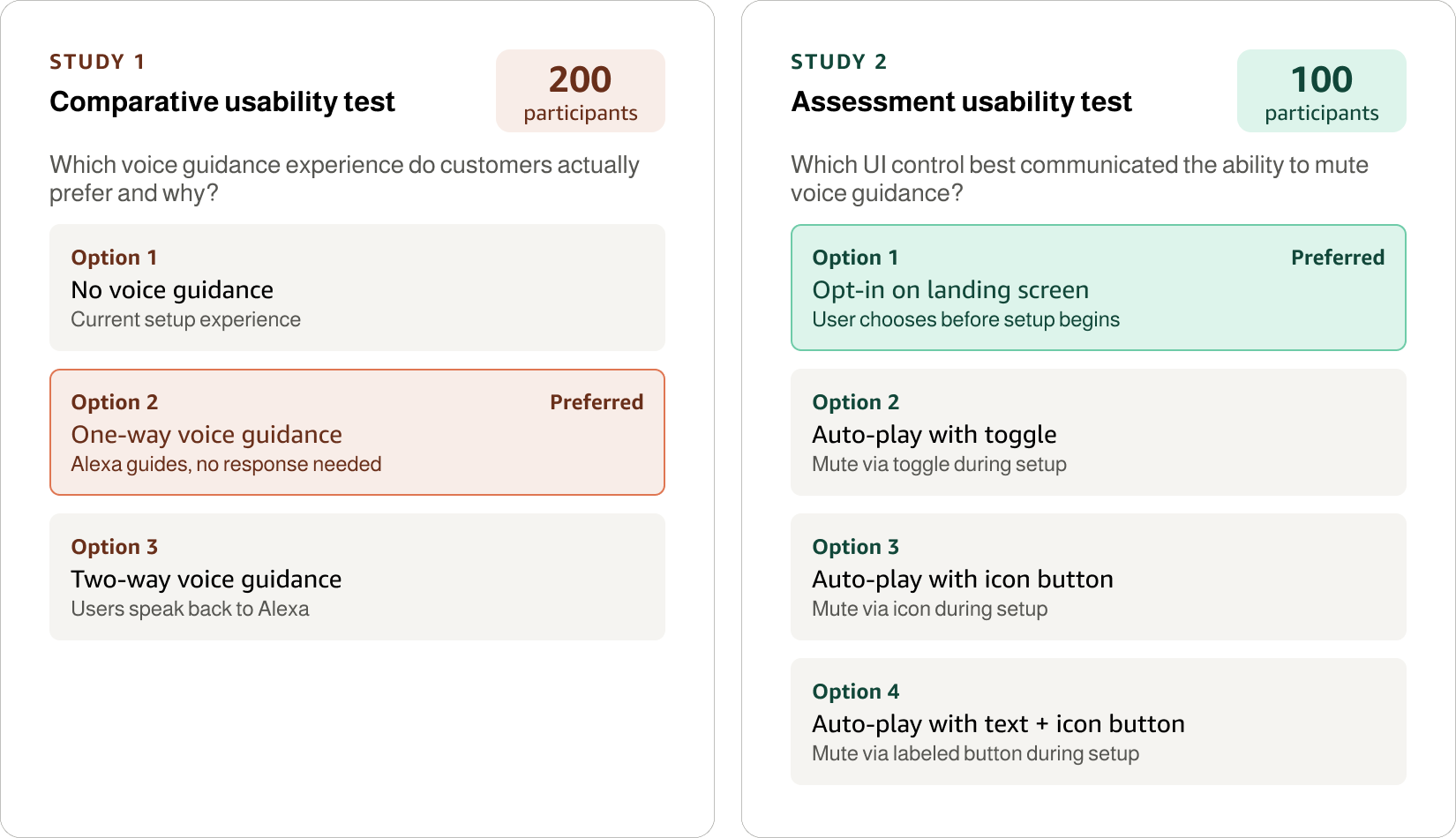
I designed and ran two independent research studies on the Dscout platform. One was a 200-participant comparative usability test and one was a 100-participant assessment usability test. This was to understand whether customers wanted voice guidance during setup, what form it should take, and what controls they needed to feel in control of the experience.
The research produced five clear findings that defined the strategic direction for voice guidance on TV. The feature went on hold due to a change in business priorities, but the work established a validated framework ready to build from.
THE QUESTION
Before designing anything, the team needed to answer three things.
Would voice guidance help or distract? Adding Alexa's voice during a screen-based setup flow could reinforce the instructions or compete with them. Customers reading on-screen text while simultaneously hearing a voice prompt might find the experience clearer, or they might find it overwhelming. We didn't know.
Would customers actually want to interact with Alexa during setup? The hypothesis assumed customers would want a two-way conversation with the voice assistant as part of setup. That felt intuitive but customers who had never used a voice assistant before might find that interaction intimidating rather than helpful.
What level of control did customers need to feel comfortable? If voice guidance played automatically, customers needed a way to turn it off. But the right UI for that control (a toggle, a button, an opt-in screen) wasn't obvious. Getting it wrong would create friction at the worst possible moment.
METHODOLOGY
Two studies. 300 participants. Two distinct questions.
I designed and ran two surveys on the Dscout platform in December 2022 and January 2023, recruiting adults 18+ across the United States screened for geographic and demographic diversity.
Study 1 — Comparative Usability Test · 200 participants
Tested three voice guidance experiences side by side using video prototypes I designed and built:
Option 1: No voice guidance — the current setup experience
Option 2: One-way voice guidance — Alexa guides users verbally without expecting a response
Option 3: Two-way voice guidance — users can speak back to Alexa during setup
Study 2 — Assessment Usability Test · 100 participants
Tested four UI approaches for the voice guidance control to understand what gave users the clearest sense of control:
Option 1: Opt-in on landing screen
Option 2: Auto-play with toggle to mute
Option 3: Auto-play with icon button to mute
Option 4: Auto-play with text and icon button to mute

(click image to view full flow)
Video Prototypes
Option 1: No voice guidance
Option 2: One-way voice guidance
Option 3: Two-way voice guidance
KEY FINDINGS
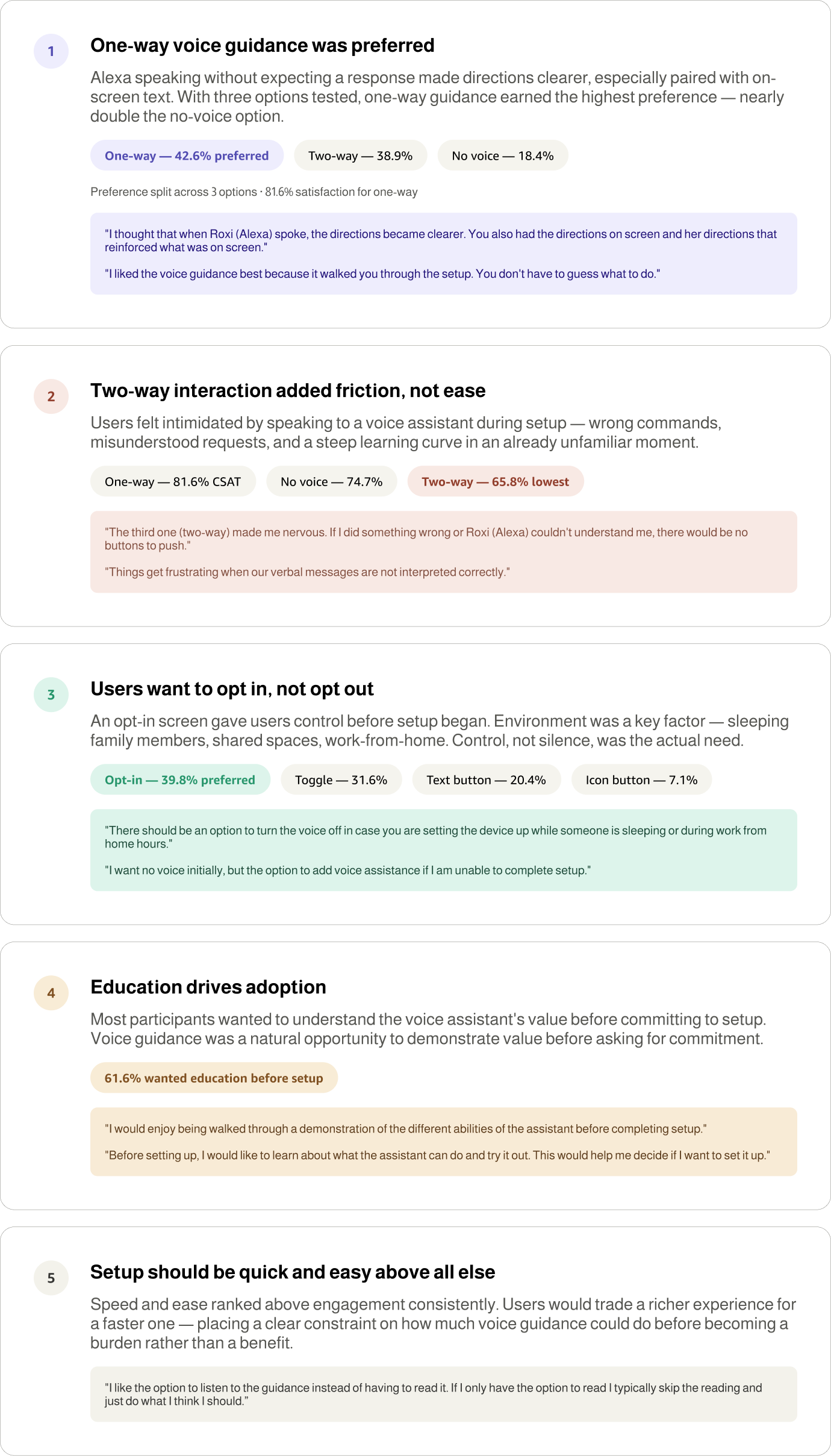
Users wanted to be guided but on their own terms.
DESIGN IMPLICATIONS
What the findings recommended.
The research produced a clear direction for how voice guidance should be designed:
Lead with opt-in: Give users the choice before setup begins, not a toggle buried mid-flow.
Design for one-way guidance: Alexa speaks, users listen. Don't ask users to interact back during a moment when they're focused on completing a task.
Voice and screen together: On-screen text and voice guidance should reinforce each other, not compete. Neither alone was as effective as both together.
Educate before you ask: Surface what Alexa can do on TV before asking users to complete setup. Demonstrated value drives adoption more reliably than instructions alone.
Make muting obvious: Control over the experience was the core user need. The opt-in screen addressed this, but a clearly visible mute option provided a reliable fallback.
Keep it brief: Every second of guidance adds to setup time. Voice guidance had to earn its place in the flow by being genuinely useful, not comprehensive.
WHAT THIS UNLOCKED
The feature went on hold. The direction didn't.
Due to changes in business priorities, voice guidance for TV setup was deprioritized before it shipped. But the research didn't disappear, it established a validated framework that any future team could build from without starting from zero.
The study answered the questions that matter most before any build decision: do customers want this, in what form, and what would make them trust it enough to use it. The work also validated a broader principle that applies beyond this specific feature: users adopt new technology more readily when they're given control, educated on the value, and not asked to do more than they're ready for in a high-stakes moment.
REFLECTION
Research is most valuable before a single screen is designed.
The PM came with a product idea. Running the research before any design work began meant the team had a validated framework to build from, not assumptions to undo later. The earlier you test, the cheaper the answer.
Control is the feature users actually want.
Every finding in this study pointed back to the same underlying need. Users wanted to feel in control of a new, unfamiliar experience. The opt-in preference, the mute visibility request, the discomfort with two-way interaction all of it was about agency.